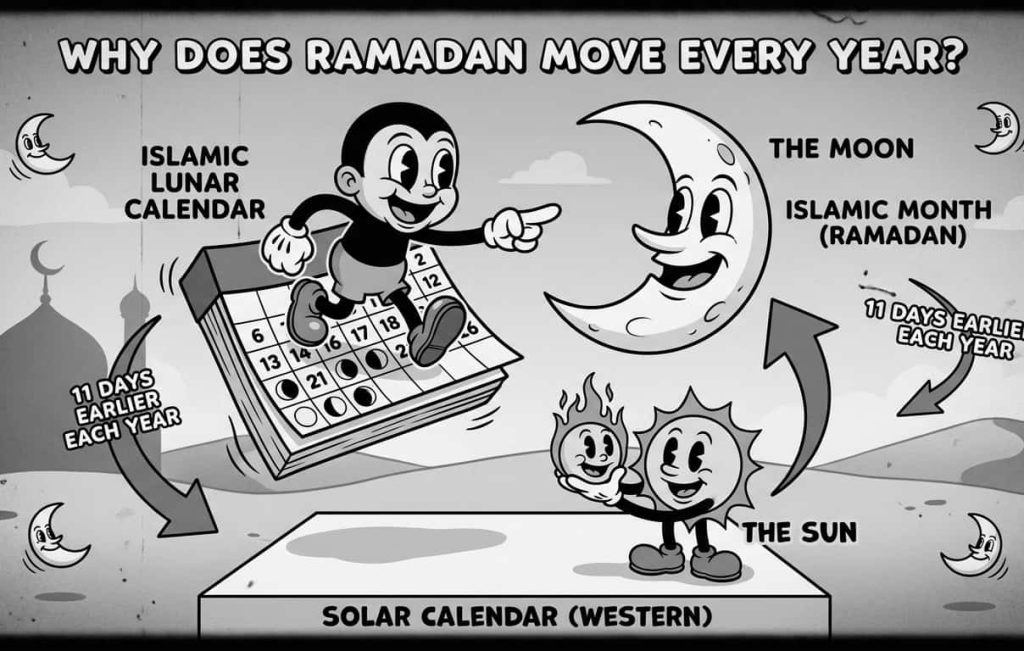
If you’ve ever wondered why Ramadan seems to arrive earlier every year, you’re not alone.
Many people notice that Ramadan sometimes falls during summer, other times during winter, and occasionally during spring or autumn.
Unlike many holidays that stay in the same season each year, Ramadan moves continuously through the calendar.
The reason lies in how the Islamic calendar works.
The Islamic Calendar Is Lunar
The Hijri calendar is based on the lunar cycle.
Each Islamic month begins with the appearance of a new moon, and a Hijri year contains twelve lunar months.
Because lunar months are shorter than solar months, the Islamic year is shorter than the Gregorian year. As a result, Islamic dates gradually move through the seasons over time.
Why Ramadan Changes Every Year
Ramadan is the ninth month of the Hijri calendar.
Since the Hijri calendar is shorter than the Gregorian calendar, Ramadan arrives earlier each year when viewed on the Gregorian calendar.
This shift continues year after year.
Over time, Ramadan moves through every season:
- Summer
- Autumn
- Winter
- Spring
Eventually the cycle repeats.
Why This Makes Ramadan Unique
One of the unique aspects of Ramadan is that Muslims experience it under different conditions throughout their lives.
Some years bring:
- Longer fasting days
- Hot weather
- Earlier Suhoor times
Other years bring:
- Shorter fasting days
- Cooler temperatures
- More comfortable conditions
Over decades, Muslims experience Ramadan in every season.
Does the Hijri Date Also Move?
Yes.
All Islamic dates move through the Gregorian calendar.
This includes:
- Ramadan
- Eid al-Fitr
- Eid al-Adha
- Ashura
- Day of Arafah
- Islamic New Year
Because they follow the Hijri calendar, their Gregorian dates change every year.
Why Tracking the Hijri Calendar Matters
Many Muslims rely on the Gregorian calendar for work, school, and daily life.
As a result, important Islamic dates can arrive unexpectedly.
Keeping track of the Hijri calendar helps you prepare for:
- Ramadan
- Sunnah fasting days
- Islamic holidays
- Important events throughout the Islamic year
A simple daily reminder can make it easier to stay aware of upcoming dates before they arrive.
An Easy Way to Stay Aware
One of the easiest ways to follow the Islamic calendar is to keep the current Hijri date visible every day.
When today’s Hijri date is displayed on your home screen, you naturally become more aware of:
- The current Islamic month
- Upcoming fasting days
- Approaching Islamic events
- Seasonal changes in the Islamic calendar
Over time, you develop a stronger connection to the rhythm of the Hijri year.
Final Thoughts
Ramadan moves every year because the Islamic calendar follows the moon rather than the sun.
This unique system allows Muslims to experience Ramadan in every season throughout their lives.
Understanding how the Hijri calendar works makes it easier to prepare for Ramadan and stay aware of important Islamic dates throughout the year.